Ontario Rent Increase Guideline 2026: What Tenants Need to Know
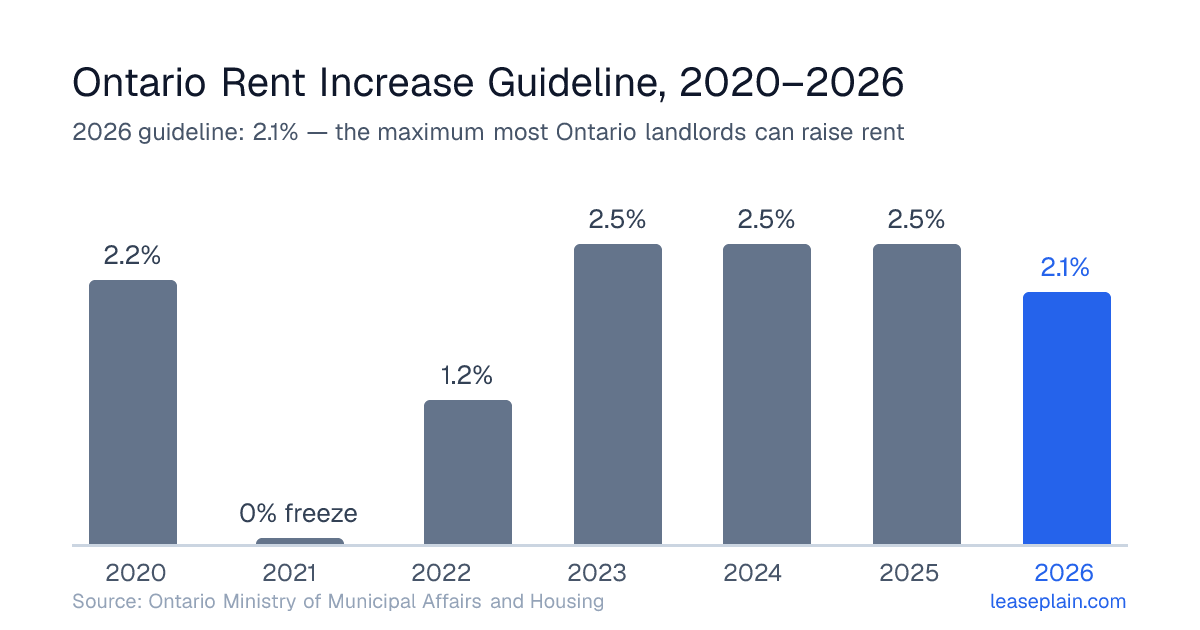
Ontario's rent increase guideline for 2026 is set at 2.1%. If your landlord has given you an increase notice, here is how to check whether it is valid — and what your options are if it is not.
What Is the 2026 Rent Increase Guideline?
Each year, the Ontario government sets a maximum percentage by which landlords can increase rent for most existing tenants. For 2026, that guideline is 2.1%. This means a landlord renting a unit covered by rent control cannot raise rent by more than 2.1% in 2026 without obtaining approval from the Landlord and Tenant Board (LTB).
The guideline is set annually by the Ministry of Municipal Affairs and Housing, based on Ontario's Consumer Price Index (CPI). Even within the guideline, a landlord can only raise rent once every 12 months, and must provide at least 90 days written notice beforehand.
Looking ahead to 2027: Ontario has announced a 1.9% guideline for 2027 — the lowest since the 2021 freeze. It applies to increases that take effect in 2027. See the full guideline history.
Which Units Are Exempt?
Not all rental units in Ontario are covered by rent control. Units that were first occupied for residential purposes after November 15, 2018 are exempt from the guideline under changes made by the previous provincial government. If your building is newer or was converted to residential use after that date, your landlord may be able to raise rent by any amount — though all other notice requirements still apply.
To determine whether your unit is subject to rent control, you can check Ontario's rental registry or contact the LTB directly. The key date is the first time the unit was ever occupied as a residential rental, not when you moved in.
How to Check if Your Increase Is Valid
Before accepting a rent increase, verify four things:
- Notice period: You must receive at least 90 days written notice before the increase takes effect.
- Frequency: Your rent can only be increased once every 12 months.
- Form N1: The notice should be provided on the official LTB Form N1, which clearly states the new rent amount and the effective date.
- Percentage: The increase must not exceed 2.1% for units subject to the guideline (unless the landlord has received an above-guideline increase order from the LTB).
Use our Rent Increase Calculator to instantly check whether a proposed increase complies with the 2026 guideline for your current rent amount.
What Is Form N1?
Form N1 is the official LTB notice a landlord must use to inform a tenant of a rent increase. It states the current rent, the proposed new rent, the percentage increase, and the date it takes effect. A rent increase communicated only through a text message, letter, or verbal conversation — without proper N1 form and sufficient notice — is not valid.
If your landlord has not used Form N1, or if the notice was given fewer than 90 days before the increase date, you are not obligated to pay the higher amount until proper notice is served.
What to Do if Your Landlord Exceeds the Guideline
If your unit is subject to rent control and your landlord proposes an increase above 2.1%, you have the right to challenge it. You do not need to pay the above-guideline portion while the dispute is ongoing. Here are your options:
- Write to your landlord explaining that the increase exceeds the 2026 guideline of 2.1% and that you will pay only the guideline amount.
- File a T1 application with the LTB if you have already paid above the guideline — this application can recover the overpaid amount.
- Contact the LTB information line at 1-888-332-3234 to get advice specific to your situation.
A landlord who wants to increase rent above the guideline — for example, due to extraordinary capital expenditures or significant operating cost increases — must apply to the LTB for an above-guideline increase (AGI) and receive approval before charging the higher amount.
For more detail on Ontario tenant rights, see our full guide on renting in Ontario.