Moving Out in Ontario: Tenant Checklist for Getting Your Deposit Back
Moving out in Ontario involves more than packing boxes. You need to serve proper written notice on the right form, conduct a move-out inspection, and understand exactly how your last month's rent deposit works — or risk leaving money behind.
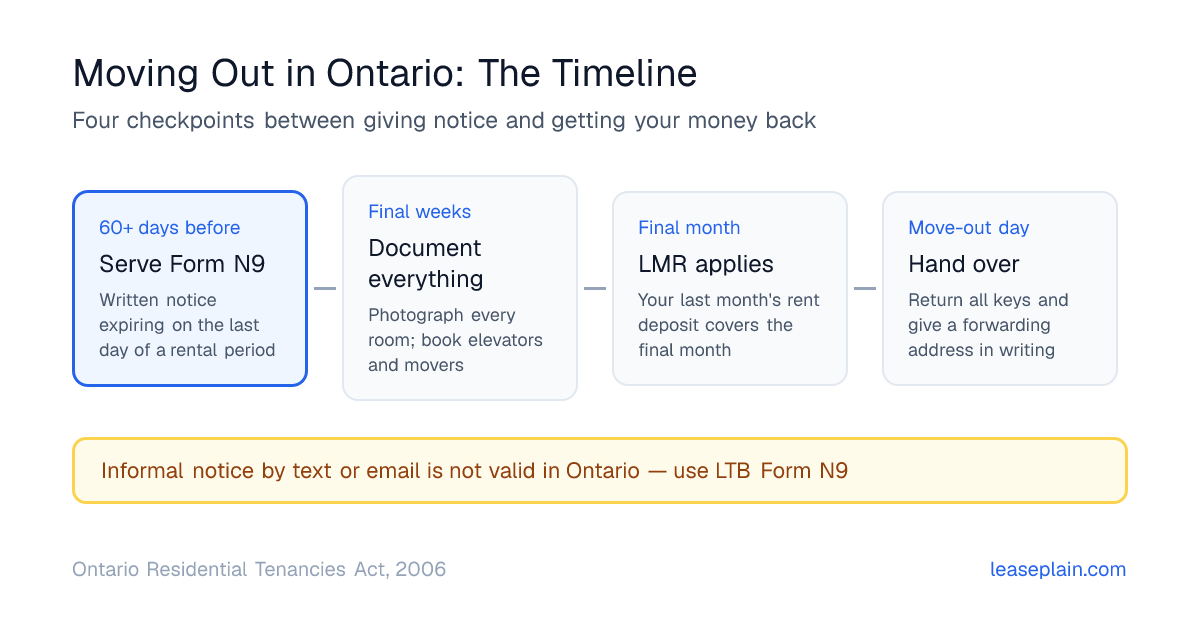
Understanding the Notice Requirement
In Ontario, tenants must give a minimum of 60 days written notice to end a tenancy, and that notice must expire on the last day of a rental period — almost always the last day of the month. This means if you want to be out by June 30, your notice must be received by your landlord no later than May 1.
The notice must be given on the official LTB Form N9 (Tenant's Notice to Terminate the Tenancy). An informal email, text, or conversation does not count as proper notice in Ontario. You must deliver it in writing — in person, by registered mail, or by courier — and keep proof.
Use the Notice Period Calculator to confirm exactly how many days' notice you need and what the last valid notice date is for your move-out date.
Last Month's Rent vs. Damage Deposit
Ontario is unique in that landlords can only collect a last month's rent (LMR) deposit — not a separate damage deposit. This is a critical distinction:
- The LMR deposit is applied to your final month of rent. You do not pay rent for that month.
- A landlord cannot deduct for cleaning, damage, or any other reason from the LMR deposit — it must be applied to rent or returned.
- The deposit earns interest at the Ontario rent increase guideline rate each year. Your landlord must either return the accumulated interest or deduct it from your last month's rent.
If a landlord tries to keep your LMR for any reason other than unpaid rent, they are acting illegally. File a T1 application at the LTB.
Your Move-Out Checklist
60+ Days Before Move-Out
- Determine your correct notice date — your notice must end on the last day of a rental period (usually the last day of the month).
- Complete LTB Form N9 (Tenant's Notice to Terminate Tenancy) — do not just send a text or informal letter.
- Deliver N9 to your landlord in writing — in person, by registered mail, or by courier. Keep proof of delivery.
- Confirm that your notice period is at least 60 days before the last day of your tenancy.
2–4 Weeks Before Move-Out
- Schedule a move-out inspection with your landlord (they are required to offer one in Ontario).
- Photograph every room, appliance, and surface — including walls, floors, fixtures, and windows. Date-stamp the photos.
- Repair any damage you caused beyond normal wear and tear before the inspection.
- Clean the unit thoroughly. Focus on oven, fridge, bathroom, and any high-use areas.
- Cancel utilities, internet, and mail forwarding effective on your move-out date.
Move-Out Day
- Return all keys, fobs, garage openers, and parking passes to the landlord.
- Conduct the move-out inspection together with the landlord if possible. Get a written sign-off.
- Take a final walkthrough with video — this is your strongest defence if a deposit dispute arises later.
- Get your landlord's contact address in writing for any future correspondence about your deposit.
After Move-Out
- Your last month's rent (LMR) deposit is automatically applied to your final month — you do not pay rent for that month.
- The landlord must return LMR interest within a reasonable time (the LMR deposit earns interest at the rent increase guideline rate each year).
- If the landlord claims deductions from your deposit for anything other than rent arrears, dispute it — Ontario has no damage deposit, so this is illegal.
- If the landlord refuses to apply your LMR or claims illegal deductions, file a T1 application with the LTB.
Breaking a Lease Early
If you need to leave before your lease ends, you have two main options in Ontario:
- Assign or sublet the unit — find a replacement tenant and request your landlord's consent (which cannot be unreasonably withheld).
- Give 60 days notice with Form N9 — you may still owe rent until the landlord finds a new tenant, but Ontario law requires landlords to make reasonable efforts to re-rent (duty to mitigate).
Use the Lease Break Cost Estimator to understand your maximum financial exposure if you break your lease early.